#32 Electricity (grades 3-8)
Regular price $23.95
Soft-bound 64-page book with 20 activity sheet lessons
We confidently recommend this winning (and wildly popular!) book as the best introduction to hands-on science. Kids love building simple, reliable, bulb-and-battery circuits with foil and paper clips, while learning to read instructions and work independently, one enthusiastic step at a time. Help your students discover how much they love science! This book is full of fun science activities and projects that will provide hours of fun as the kids move from one cool science project to the next. Scroll down to take a look at the free science experiment from this book.
Click here for a complete list of materials and convenient shopping.
masking tape, aluminum foil, scissors, size-D dry cells, flashlight bulbs, paper clips, rubber bands, pennies index cards, paper punch tools, clothespins, steel wool, straight pins, balloons- Lesson 1: To discover by trial and error how to light a bulb with a dry cell and foil ribbon.
- Lesson 2: To further explore by trial and error the different ways to light a bulb with a dry cell and foil ribbon.
- Lesson 3: To use the idea of contact points in predicting whether a bulb will light. To test theses predictions by experiment.
- Lesson 4: To learn how to connect cells in series and opposition. To understand how this affects bulb brightness.
- Lesson 5: To learn how to connect cells in parallel. To understand how this affects bulb brightness.
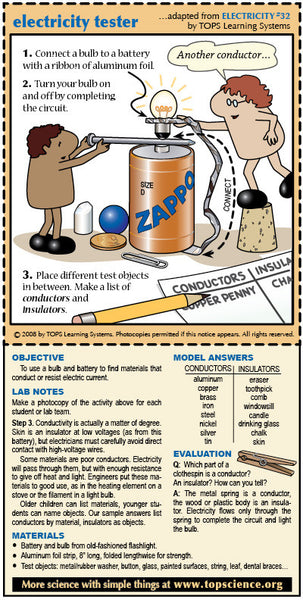
- Lesson 6: To use a bulb and cell to test whether common materials in the classroom are conductors or insulators.
- Lesson 7: To construct a circuit puzzle. To find, by trial and error, those holes that are connected by foil and those that are not.
- Lesson 8: To make a bulb holder, and complete construction of a dry cell holder for use in future activities.
- Lesson 9: To make a switch and integrate it into a simple circuit. To study how alternate pathways around the bulb and switch affect the circuit.
- Lesson 10: To learn to draw simple circuit diagrams using accepted symbols. To predict how electrons should flow through the wires.
- Lesson 11: To practice mapping and drawing more complicated circuit diagrams. To predict how electrons should flow through these circuits.
- Lesson 12: To learn how to connect dry cells and bulbs to achieve maximum brightness.
- Lesson 13: To understand why electricians wire buildings in parallel rather than in series.
- Lesson 14: To understand how length and diameter affect electrical resistance in wire.
- Lesson 15: To watch a miniature fireworks show! To appreciate that high electrical resistance can create heat and light.
- Lesson 16: To appreciate that the flow of electricity decreases with increased resistance.
- Lesson 17: To understand how fuses work to protect circuits from shorts and overloads.
- Lesson 18: To explode a balloon with electricity by throwing a switch. To understand the role of electrical resistance in this dramatic process.
- Lesson 19: To build 2-way switches and integrate them into a circuit. To understand how they work.
- Lesson 20: To trace the flow of electricity through pairs of light bulbs. To recognize unusual series and parallel connections.
A Cheap Light Bulb Alternative:
A string of steady (unblinking), incandescent (not LED), Christmas tree lights may be substituted for 4.5 volt bulbs. You can estimate the the voltage of each bulb in any string of lights by dividing the recommended-use voltage (usually 110 volts) by the total number of bulbs. Thus:
• Each light in a 24 bulb string receives 4.5 volts.
• Each light in a 37 bulb string receives 3.0 volts.
• Each light in, say, a 20 bulb string may have too high a voltage requirement to glow with 1 battery.
• Each light in, say, a 40 bulb string may have too low a voltage to keep shining with 3 series D-cells without burning out.
So strings of lights between 20 and 40 bulbs may possibly work, and it may be worth the risk of cutting such a strand apart to find out: IF a single bulb in the string glows perceptibly with one size-D battery, AND won't burn out with three size-D's in series, you've got your cheap alternative. Divide the lights in the string by cutting halfway between each bulb. Strip insulation from the ends of the wire leads, and use masking tape to connect about 6 cm of conducting ribbon (aluminum foil backed by tape) to each exposed wire. To make the connections extra secure, poke a pinhole through the folded ribbon, thread the exposed wire through, and bend it back on itself before taping. ART?
Caution: some manufacturers currently warn about lead residue on light strings. As a precaution, wash hands with soap and water after handling, and avoid touching hands to face or clothing during labs.
We have linked these TOPS Activity Sheets to the national standards. You may have state or district-level compliance issues not addressed by the national framework. To keep our presentation relevant to local as well as national perspectives, we fully elaborate ALL science content contained in this work, including topics not specifically named in the NRC document.
Teaching Standards
These 20 Activity Sheets promote excellence in science teaching by these NSES criteria:
Teachers of science...
…plan an inquiry-based science program.
…guide and facilitate learning.
…engage in ongoing assessment of their teaching and of student learning.
…design and manage learning environments
…provide students with time, space, and resources for learning science.
Content Standards
These 20 Activity Sheets contain fundamental content as defined by these NSES guidelines (p. 109).
* Represents a central event or phenomenon in the natural world.
* Represents a central scientific idea and organizing principle.
* Has rich explanatory power.
* Guides fruitful investigations.
* Applies to situations and contexts common to everyday experiences.
* Can be linked to meaningful learning experiences.
* Is developmentally appropriate for students at the grade level specified.
Electrons move from the negative end of a battery to the positive end through closed circuits, following paths of least resistance.
Science as Inquiry (content standard A):
Fiddle with a battery and strip of foil until you make a bulb light. Say how you did it in words and pictures. Can you build a circuit so each light turns on and off independently?
Physical Science (content standard B):
NSES Framework: electricity • heat • light • properties and changes in matter • transfer of energy Core Inquiries: series and parallel circuits • opposition • conductors and insulators of electricity • resistance • open and closed circuits • short circuits • fuses • circuit diagrams • trouble shooting • electrostatic attraction and repulsion
Science and Technology (content standard E):
Construct bulb holders, battery holders and switches. Draw circuit diagrams and describe their properties. Beware of battery-draining short circuits!