#34 Pendulums(grades 4-9)
Regular price $23.95
Soft-bound, 64 page book, 20 reproducible activity sheets, full teaching notes.
Time pendulums, count cycles, measure lengths, graph data, predict frequency, calculate ratios, and even discover the square root of two. Couple pendulums with a rubber band to watch the energy flow back and forth. Join four pendulums with a raft of heavy books and watch the complex harmonic motion draw a seashell pattern. Great science, great math, great art, all done with simple materials.
More Information – click any of the tabs below to learn more about this title
Click here for a complete list of materials and convenient shopping.
paper clips, thread, scissors, masking tape, wall clock, meter sticks, styrofoam cups, drinking straws, rubber bands, pennies, wire clothes hangers, string, clothespins, felt-tip pens -- must be smooth and free-flowing- Lesson 1: To make 3 pendulums that swing in step. To understand how their lengths change with frequency.
- Lesson 2: To find by trial and error how long a pendulum must be to tick out time like a clock -- 60 cycles to a minute.
- Lesson 3: To determine whether changes in bob weight affect the frequency of a pendulum.
- Lesson 4: To discover whether changes in amplitude affect the frequency of a pendulum.
- Lesson 5: To understand why the length of a pendulum must be measured from the pivot to the center of the bob.
- Lesson 6: To practice finding the frequency of pendulums in cycles/minute.
- Lesson 7: To discover a square relationship between the length of a pendulum and its frequency.
- Lesson 8: To find the frequency of pendulums by experiment and by mathematical reasoning.
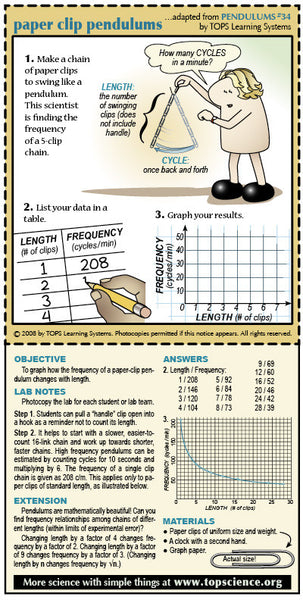
- Lesson 9: To make a pendulum graph out of paper clips and thread. To understand the idea of graphing in concrete terms.
- Lesson 10: To graph pendulum frequency as a function of length. To understand pendulum graphs in abstract terms.
- Lesson 11: To mathematically predict the frequencies of paper-clip chains. To confirm these predictions by experiment.
- Lesson 12: To graph how the frequency of a paper-clip chain changes with length.
- Lesson 13: To learn how to transfer energy to a swinging pendulum by pushing in time with its natural frequency.
- Lesson 14: To observe energy transfers in coupled pendulums of equal and unequal length. To account for observed differences in terms of sympathetic pushes.
- Lesson 15: To observe energy transfers in two pendulums that wind around each other. To predict how this motion changes as you make one pendulum longer than the other.
- Lesson 16: To calculate the square root of 2, first by using pendulums, then by using simple geometry.
- Lesson 17: To graph how the weight of a pendulum bob affects amplitude decay in a pendulum.
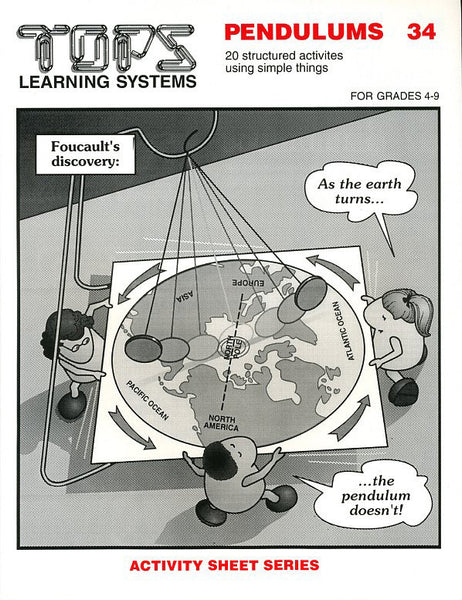
- Lesson 18: To build a model of Foucault's pendulum. To understand how it demonstrates Earth's rotation.
- Lesson 19: To graph how the frequency of a diving board changes with increased bob weight. To contrast this result with previous pendulum graphs.
- Lesson 20: To use pendulum motion to create beautiful "seashell" designs. To have fun!
We encourage improvisation - it's one of the main goals of our hands-on approach! You and your students might invent a simpler, sturdier or more accurate system; might ask a better question; might design a better extension. Hooray for ingenuity! When this occurs, we'd love to hear about it and share it with other educators.
National Science Education Standards (NRC 1996)
Teachers of science...
A: ...plan an inquiry-based science program. (p. 30)
B: ...guide and facilitate learning. (p. 32)
C: ...engage in ongoing assessment of their teaching and of student learning. (p. 37)
D: ...design and manage learning environments that provide students with the time, space, and resources needed for learning science. (p. 43)
• Represent a central event or phenomenon in the natural world.
• Represent a central scientific idea and organizing principle.
• Have rich explanatory power.
• Guide fruitful investigations.
• Apply to situations and contexts common to everyday experiences.
• Can be linked to meaningful learning experiences.
• Are developmentally appropriate for students at the grade level specified.
Core Concepts/Processes: Explore change, constancy, measurement and pattern in pendulum systems. • Study frequency variables that really matter (length); that don't matter (bob weight); that matter a little (amplitude)
Core Inquiries: Time Pendulums • Measure Lengths • Record Data • Graph Variables • Predict Frequency
Core Content: Build a working model of Foucault's pendulum.
TEACHING Standards
These 20 Activity Sheets promote excellence in science teaching by these NSES criteria:Teachers of science...
A: ...plan an inquiry-based science program. (p. 30)
B: ...guide and facilitate learning. (p. 32)
C: ...engage in ongoing assessment of their teaching and of student learning. (p. 37)
D: ...design and manage learning environments that provide students with the time, space, and resources needed for learning science. (p. 43)
CONTENT Standards
These 20 Activity Sheets contain fundamental content as defined by these NSES guidelines (p. 109).• Represent a central event or phenomenon in the natural world.
• Represent a central scientific idea and organizing principle.
• Have rich explanatory power.
• Guide fruitful investigations.
• Apply to situations and contexts common to everyday experiences.
• Can be linked to meaningful learning experiences.
• Are developmentally appropriate for students at the grade level specified.
Unifying Concepts and Processes
NSES Framework: Systems, order, and organization • Evidence, models and explanation • Constancy, change, and measurement • Evolution and equilibrium • Form and functionCore Concepts/Processes: Explore change, constancy, measurement and pattern in pendulum systems. • Study frequency variables that really matter (length); that don't matter (bob weight); that matter a little (amplitude)
Science as Inquiry (content standard A)
NSES Framework: Identify questions that can be answered through scientific investigations. • Design and conduct a scientific investigation. • Use appropriate tools and techniques to gather, analyze, and interpret data. • Develop descriptions, explanations, predictions, and models using evidence. • Think critically and logically to make the relationships between evidence and explanations. • Recognize and analyze alternative explanations and predictions. • Communicate scientific procedures and explanations • Use mathematics in all aspects of scientific inquiry.Core Inquiries: Time Pendulums • Measure Lengths • Record Data • Graph Variables • Predict Frequency
Physical Science (content standard B)
NSES Framework: Motions and forces • Transfer of energy • Conservation of energy
Core Content: Explore how length, amplitude and bob weight affect pendulum frequency • Collect and graph data • Examine energy transfers • Sympathetic pulses • Half life
History and Nature of Science (content standard G)
NSES Framework: Science as a human endeavor • Nature of science • History of scienceCore Content: Build a working model of Foucault's pendulum.